
Quick Answer
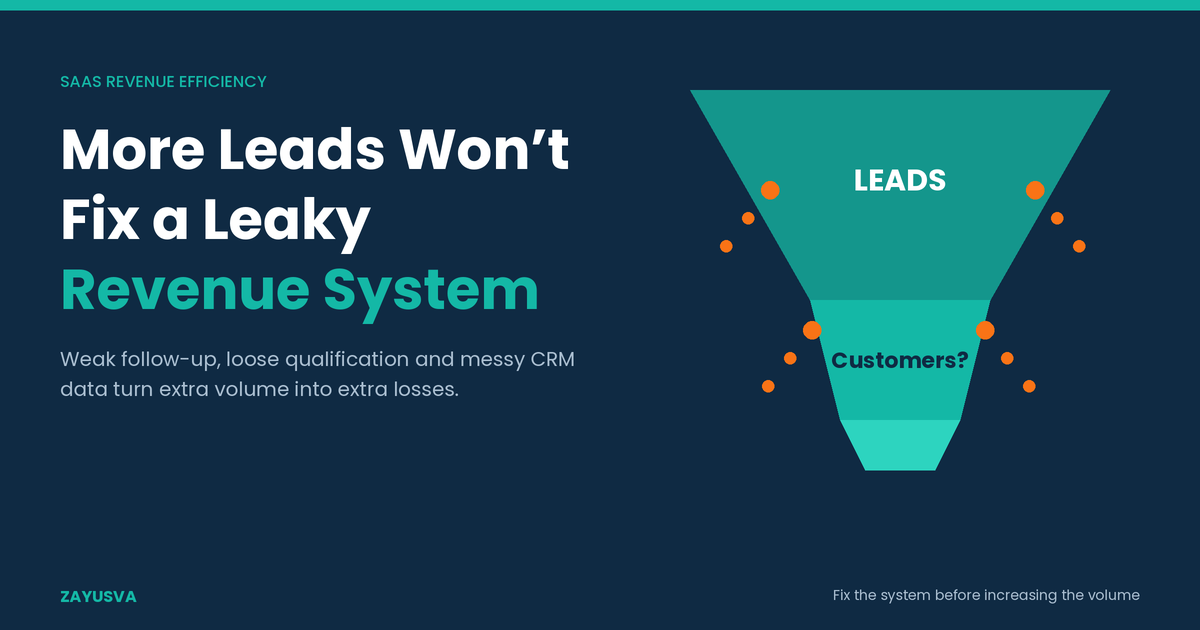
More leads rarely fix SaaS revenue problems when the existing system cannot convert them efficiently. If leads stall, follow-ups break, or the CRM lacks clear revenue logic, adding more volume only increases the pressure on the system.
The problem may not be lead generation.
It may be what happens after the lead arrives.
More Leads Can Hide the Real Problem
When revenue slows, the first instinct is often predictable.
Get more leads.
Increase ad spend.
Send more outreach.
Fill the pipeline.
That sounds logical.
More opportunities should create more revenue.
However, that only works when the system can handle and convert them.
If conversion is weak, more leads simply create more opportunities to lose.
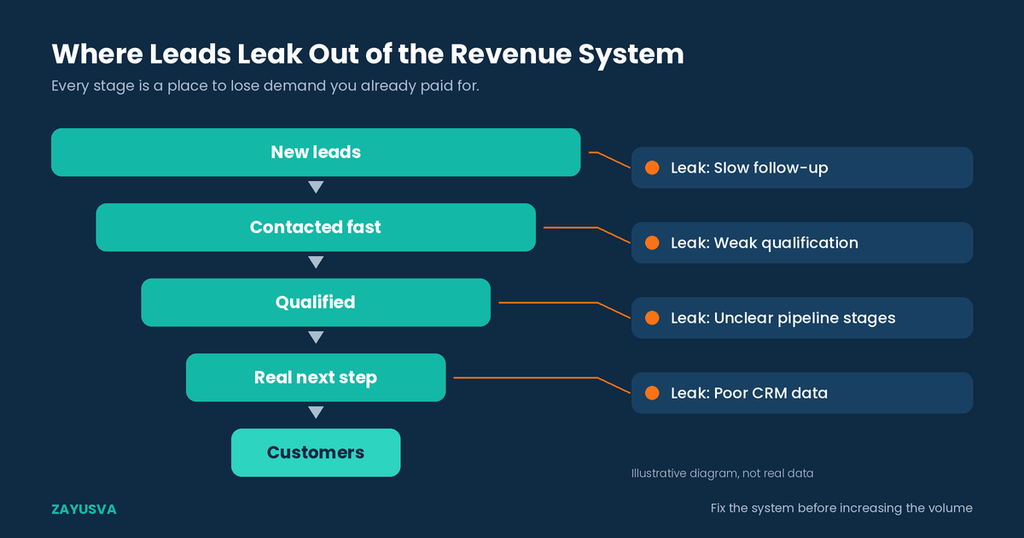
1. Your Existing Leads May Already Be Underused
Before generating more demand, look at the demand you already have.
Ask:
- How quickly are leads contacted?
- How many receive consistent follow-up?
- How many become qualified opportunities?
- Where do opportunities stop moving?
- How many eventually become customers?
These questions reveal whether the problem starts with lead volume.
Often, it does not.
The business already has opportunities.
The system simply fails to move enough of them forward.
2. More Leads Increase Operational Pressure
Every new lead creates work.
Someone must:
- capture it
- qualify it
- route it
- follow up
- update the CRM
- move it through the pipeline
If those processes already create friction, more volume increases the problem.
The team becomes busier.
However, revenue may not increase proportionally.
That is revenue inefficiency.
3. Slow Follow-Up Can Waste New Demand
Lead generation creates opportunity.
Speed determines what happens next.
A lead that waits too long may lose interest.
A qualified opportunity may move toward a competitor.
A salesperson may forget to follow up.
These problems become harder to manage as volume increases.
Therefore, fixing the follow-up system can create more value than simply generating more leads.
This connects directly to How Smart Automation Cuts Response Times in Half, where I explain how automation can strengthen the revenue flow after a lead enters the system.
4. Weak Qualification Creates a Bigger Pipeline, Not Better Revenue
A large pipeline can look impressive.
It can also be misleading.
If the pipeline contains poorly qualified opportunities, the number tells you very little.
You need to know:
- who is actually qualified
- which opportunities have buying intent
- which deals have clear next steps
- which opportunities are genuinely progressing
Otherwise, more lead generation simply creates a larger amount of noise.
5. More Leads Cannot Fix Broken Pipeline Logic
A pipeline should represent buyer progression.
If stages are unclear, adding leads will not solve the problem.
It will simply fill the wrong stages faster.
For example, an opportunity may remain marked as active without a real next step.
Another deal may sit in the wrong stage because the salesperson interprets the process differently.
Eventually, the pipeline looks healthier than reality.
That creates forecasting problems too.
This is why The Difference Between CRM Setup and CRM System Design matters. A CRM should represent how revenue actually moves through the business.
6. Poor Data Makes More Leads Harder to Manage
More leads mean more data.
If your CRM already contains duplicate records, missing information, or inconsistent fields, additional volume makes the problem worse.
The team spends more time cleaning information.
Managers spend more time checking reports.
Forecasts become harder to trust.
Consequently, the business gains more activity but less clarity.
This is why Why Clean Data Is the Foundation of Predictable Revenue is an important part of the wider system.
7. A Full Pipeline Does Not Guarantee Revenue
This is one of the biggest traps.
Founders see opportunities increasing.
They assume revenue will follow.
However, pipeline volume only matters when opportunities move.
A useful pipeline should help answer:
- How fast are deals progressing?
- Where are they slowing?
- Which stages convert?
- How long do opportunities remain stuck?
- Which deals have a realistic path to revenue?
Without those answers, pipeline size can become a vanity metric.
What to Fix Before Chasing More Leads
If revenue is under-performing, look at the system first.
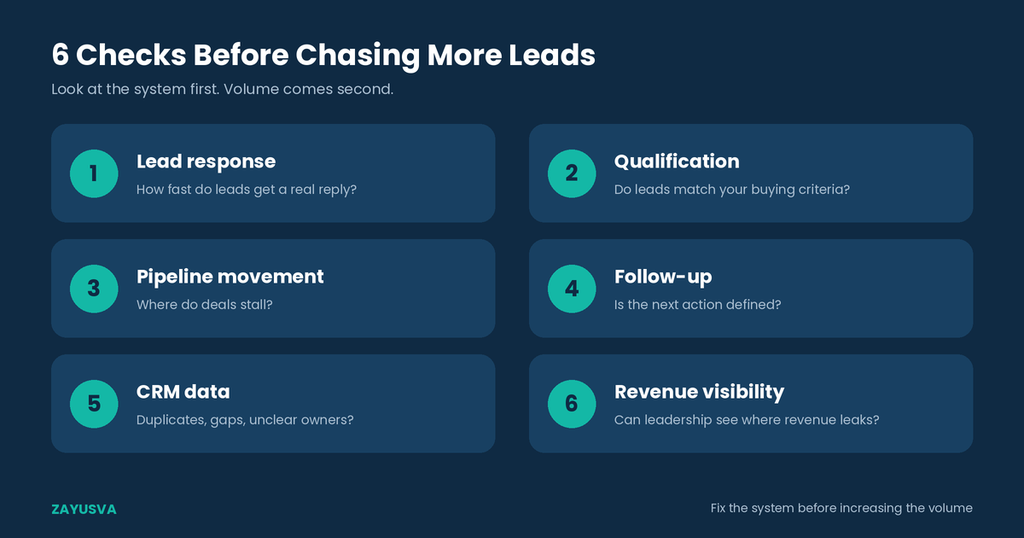
Step 1: Check Lead Response
Measure how quickly new leads receive a meaningful response.
Then identify where delays occur.
Step 2: Check Qualification
Review whether leads entering the pipeline actually match your buying criteria.
Remove unnecessary noise.
Then create clearer qualification rules.
Step 3: Check Pipeline Movement
Look at how long opportunities remain in each stage.
Identify stages where deals consistently stall.
Those bottlenecks deserve attention before additional volume.
Step 4: Check Follow-Up
Review what happens when an opportunity does not respond.
Is there a defined process?
Or does someone need to remember what to do?
A strong system makes the next action clear.
Step 5: Check CRM Data
Look for:
- duplicate records
- missing information
- inconsistent stages
- outdated opportunities
- unclear ownership
Reliable data makes every other improvement easier.
Step 6: Check Revenue Visibility
Finally, ask whether leadership can see what actually happens after leads enter the CRM.
You should be able to identify:
- where leads convert
- where they stall
- where revenue leaks
- which processes create delays
- which stages produce the strongest outcomes
If you cannot, generating more leads is probably premature.
When More Leads Actually Make Sense
This does not mean lead generation is unimportant.
It means sequence matters.
More leads make sense when the existing revenue system can handle them.
You want:
- clear qualification
- reliable routing
- fast follow-up
- defined pipeline stages
- trustworthy data
- measurable conversion
- clear ownership
Once those foundations work, increasing volume can amplify the system.
That is when lead generation becomes a growth lever rather than a distraction.
Fix the System Before Increasing the Volume
Think about it this way.
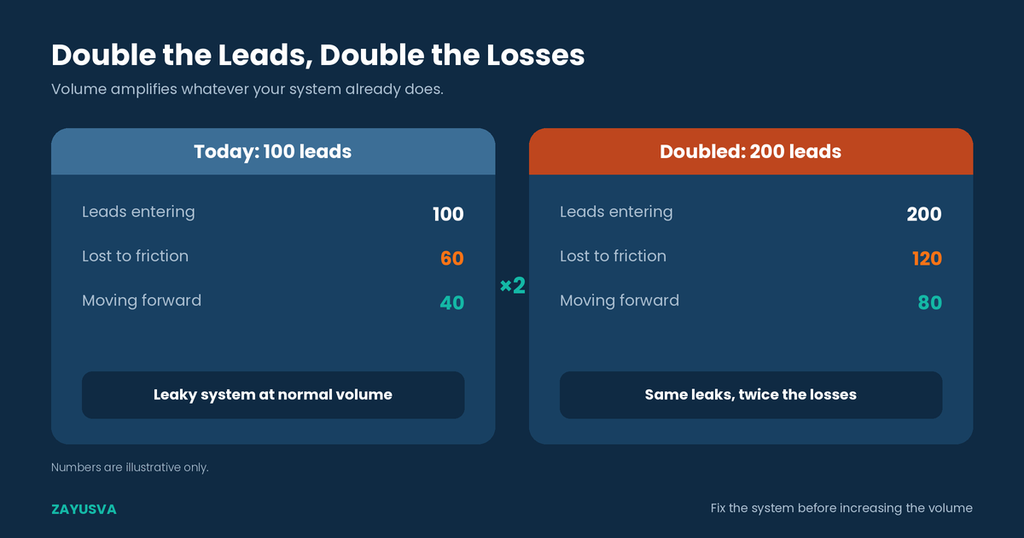
If your system converts 10% of qualified opportunities, doubling lead volume can increase the number of conversions.
But if the system loses opportunities through slow follow-up, poor qualification, or broken hand-offs, doubling lead volume also doubles the opportunities you can lose.
The better question is not:
“How do we generate more leads?”
It is:
“What happens to every lead after it enters our revenue system?”
That question gets much closer to the real problem.
Check Your Revenue Efficiency
If your team is generating leads but revenue is not keeping pace, don’t assume you need more leads.
First, check how efficiently your current revenue system works.
Look at:
- how quickly leads receive follow-up
- how many leads become qualified opportunities
- where deals stall in the pipeline
- how much manual work slows the team
- whether your CRM data supports reliable decisions
These numbers can reveal whether your growth problem starts with lead volume or somewhere deeper in the revenue system.
Check Your Revenue Efficiency to see where your current system is creating friction and where the biggest opportunities for improvement may be.e your current revenue system is limiting growth.
Key Takeaways
- More leads cannot compensate for weak conversion systems.
- Lead volume increases pressure on existing processes.
- Slow follow-up can waste otherwise valuable demand.
- Poor qualification creates pipeline noise.
- Broken CRM logic makes more leads harder to manage.
- Clean data supports better revenue decisions.
- More leads become powerful when the underlying revenue system works.