
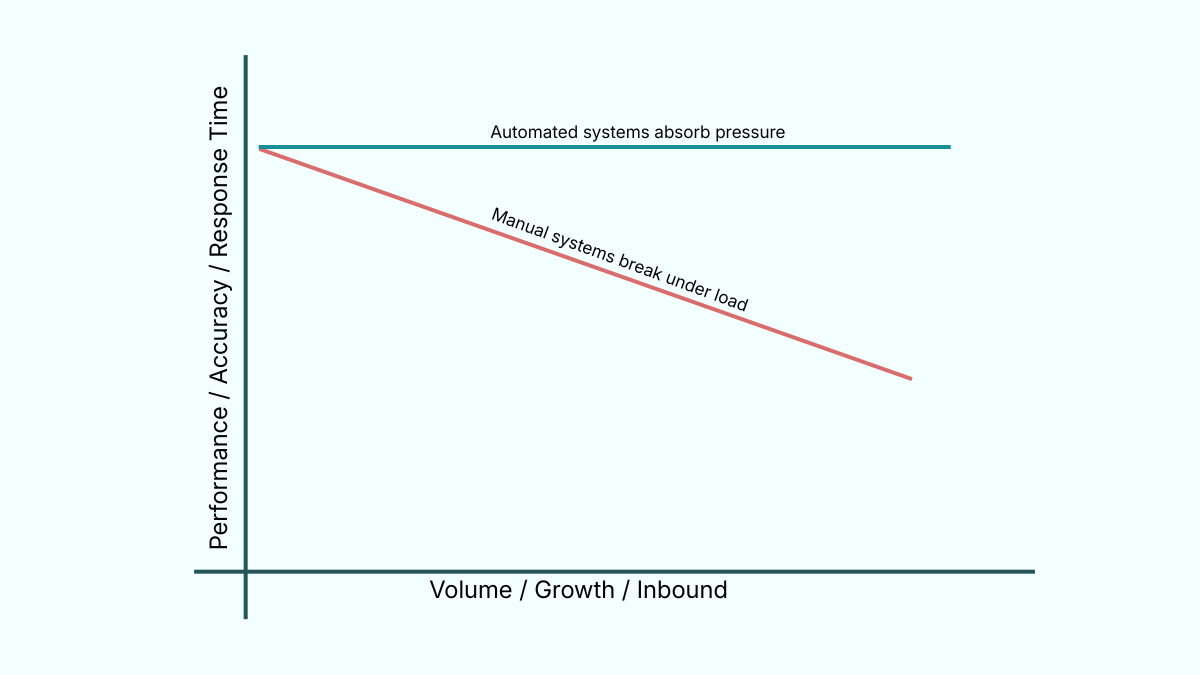
Most teams don’t break because they grow too fast.
They break because they grow without structure.
What looks like “scale” from the outside often feels like chaos on the inside:
- deals slipping
- reps overwhelmed
- follow-ups missed
- dashboards lying
- automation half-working
- founders constantly firefighting
And the default explanation is always the same:
“We just need better people.”
“We just need to work harder.”
“We just need more leads.”
No.
You need a system that can handle growth without falling apart.
Let’s break down what that actually means — and why most teams get it wrong.
1. Chaos Is a System Problem, Not a People Problem
When things start breaking at scale, the instinct is to blame execution.
But chaos shows up when:
- processes aren’t defined
- logic isn’t enforced
- automation is missing
- responsibilities are unclear
- consistency depends on memory
Good people don’t fail randomly.
They fail inside broken systems.
If your operation requires people to “remember” what to do next, it won’t scale. It will fracture.
2. Scale Exposes Weak Follow-Up First
Follow-up is usually the first thing to collapse under growth.
Why?
Because it’s repetitive.
Because it’s timing-sensitive.
Because it’s easy to delay.
When volume increases, follow-up becomes:
- inconsistent
- late
- generic
- forgettable
And deals quietly die.
This isn’t a motivation issue.
It’s a logic issue.
If follow-up breaks as you scale, the underlying problem is weak logic. I break this down in detail in my article on how poor follow-up logic quietly kills SaaS deals.
3. Dashboards Create a False Sense of Control
Dashboards tell you what already happened.
They don’t tell you:
- what’s about to break
- where leads are decaying
- which deals are stalling
- which steps are being skipped
So founders think things are “fine” — until revenue stalls.
By the time the dashboard reflects the damage, the system has already failed.
This is one of the biggest blind spots in growing teams. I explain why dashboards hide these failures — and how to uncover them — in my breakdown of the blind spots you can’t see from the dashboard.
4. Automation Should Reduce Decisions, Not Add Tools
Most teams don’t lack software.
They lack logic.
They add tools instead of removing decisions.
Real automation:
- enforces consistency
- removes manual judgment
- triggers actions automatically
- prevents mistakes
- protects momentum
If your automation requires constant babysitting, it’s not automation. It’s chaos in disguise.
When automation is incomplete or poorly designed, it slows everything down. I go deeper into the automation gaps that quietly drag SaaS sales cycles out longer than they should be.
5. Stagnation Is the Silent Killer of Scale
Scale doesn’t fail loudly.
It fails slowly.
Deals sit.
Leads stall.
No one notices.
Without stagnation logic:
- nothing escalates
- nothing triggers
- nothing gets recycled
- nothing gets fixed
A scalable system doesn’t wait for problems to be noticed.
It surfaces them automatically.
6. Systems Should Absorb Pressure, Not Transfer It
Here’s the real test of scalability:
When volume increases, does pressure:
- land on people?
- or get absorbed by the system?
If reps feel overwhelmed as soon as things grow, your system isn’t supporting scale — it’s transferring chaos downward.
Strong systems protect:
- people
- focus
- consistency
- decision-making
That’s how you grow without burning teams out.
What a System That Supports Scale Actually Looks Like
A scalable operation isn’t complicated.
It’s deliberate.
It has:
1. Clear process ownership
2. Defined logic at every stage
3. Automated follow-up and routing
4. Behavior-based triggers
5. Stagnation detection
6. Automation enforcing standards
7. Visibility into what’s breaking before it breaks
When these are in place, scale feels boring.
And boring is good.
Want to Know If Your System Supports Scale?
If growth feels chaotic right now, I’ll help you find out why — for free.
Book your free SaaS system audit call here.
I’ll walk you through:
- where chaos is being created
- which systems are missing
- where automation should absorb pressure
- why deals slip as volume rises
- exactly what to fix first
You’ll leave with clarity — with or without my help.